
Personal Finance & Career: Practical Tools, Books & Resources for U.S. Professionals
Practical personal finance and career resources for U.S. professionals, covering budgeting, saving, debt, investing education, career development, productivity, home-office tools, side hustles and entrepreneurship.
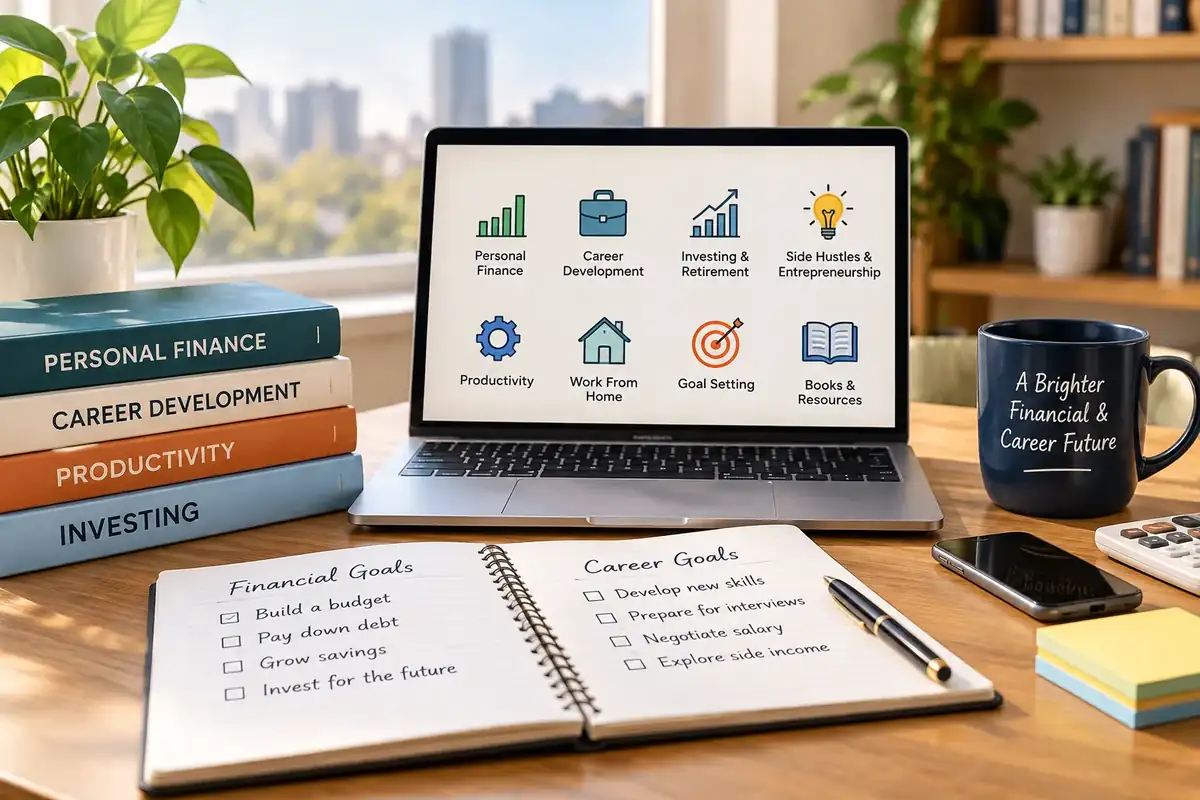
Managing money and building a career are closely connected. Your income affects how much you can save, invest, and put toward debt, while your career decisions can influence your financial options for years.
But improving your financial life doesn't necessarily require complicated strategies or expensive services. For many people, the biggest improvements come from understanding where their money goes, developing useful career skills, organizing their work, and choosing practical tools that make good habits easier to maintain.
This CoreAdorn guide brings together practical resources for personal finance, career development, productivity, remote work, entrepreneurship, and side hustles. It is designed for U.S. consumers who want straightforward information and useful products without having to sort through dozens of unrelated recommendations.
Whether you're trying to build a budget, prepare for a job interview, improve your home office, negotiate compensation, or explore a side business, start with the section that matches your current goal.
Quick Answer: What Should You Focus on First?
If you're not sure where to begin, think about your biggest current need.
| Your Goal | Start Here | Useful Resources |
|---|---|---|
| Control everyday spending | Budgeting & saving | Budget planners, expense trackers, finance books |
| Pay down debt | Debt management | Debt planners, budgeting tools, financial workbooks |
| Build long-term wealth | Investing & retirement | Investing books, retirement resources, planning tools |
| Find or change jobs | Career development | Career planners, resume tools, interview books |
| Improve your income | Salary & professional development | Negotiation books, career resources, skill-building books |
| Work more effectively | Productivity | Planners, notebooks, time-management tools |
| Improve your remote workspace | Home office | Desks, chairs, monitors, laptop accessories |
| Build additional income | Side hustles & entrepreneurship | Business books, planners, organizational tools |
When you buy through links on our site, we may earn an affiliate commission at no extra cost to you. This helps support our work.
Who This Guide Is For
This guide is intended primarily for U.S. adults who want practical ways to organize their finances, improve their careers, or make their work lives more manageable.
- Young professionals starting to manage money independently
- People creating their first household budget
- Workers trying to reduce debt
- Professionals preparing for a job change
- People preparing for interviews
- Employees planning a promotion or compensation discussion
- Remote and hybrid workers
- Freelancers and independent professionals
- People exploring a side hustle
- Small-business owners looking for organizational tools
- Anyone interested in improving financial and career habits
The products and books discussed throughout this category are tools, not substitutes for personalized financial, tax, legal, employment, or investment advice.
Personal Finance
Personal finance covers much more than investing. Before worrying about complicated investment strategies, most households need a workable system for managing income, spending, debt, savings, and financial records.
Budgeting
A budget gives you a way to see where your money is going and decide where you want it to go.
A basic budget typically considers:
- Monthly income
- Housing
- Utilities
- Transportation
- Food
- Insurance
- Debt payments
- Subscriptions
- Personal spending
- Savings
- Investments
- Irregular or annual expenses
Some people prefer spreadsheets or budgeting apps. Others find that physically writing down expenses makes them more aware of their spending.
For people who prefer a physical system, planners, budget binders, expense trackers, and cash-envelope systems are common options.
What to Look for in a Budget Planner
A useful budget planner may include:
- Monthly income sections
- Fixed and variable expense tracking
- Savings goals
- Debt tracking
- Spending categories
- Monthly summaries
- Annual financial goals
- Space for notes
The right format depends on how detailed you want your budgeting system to be.
Someone who wants a quick monthly overview may prefer a simple planner. Someone managing several debts or multiple financial goals may want a more detailed workbook.
Saving Money
Saving is easier to manage when it is treated as a specific financial goal rather than whatever money happens to be left at the end of the month.
Common savings goals include:
- Emergency savings
- Vacation funds
- Home-related expenses
- Car expenses
- Education
- Large purchases
- Annual bills
- Short-term financial goals
A savings tracker or financial planner can help make progress visible.
The physical product itself isn't what creates savings. The value comes from having a system that helps you consistently track your goal and spending.
Debt Management
Debt management starts with knowing exactly what you owe.
For each debt, you may want to record:
- Current balance
- Interest rate
- Minimum payment
- Due date
- Additional payment
- Remaining balance
- Payment history
A debt payoff planner can make this information easier to organize.
Two commonly discussed approaches are the debt snowball and debt avalanche methods. The snowball approach generally prioritizes smaller balances first, while the avalanche approach generally prioritizes higher-interest debt.
Neither method eliminates the underlying debt. The important part is having accurate information and a repayment system you can consistently follow.
If debt organization is your main goal, our guide to debt payoff planners and financial organization tools can help you compare different formats.
Investing Education
Investing is an area where education matters because different investments involve different levels of risk, time horizons, costs, and potential returns.
Before buying an investment, it helps to understand concepts such as:
- Stocks
- Bonds
- Mutual funds
- Exchange-traded funds
- Index funds
- Diversification
- Asset allocation
- Investment fees
- Risk tolerance
- Time horizon
- Compounding
Books can be useful for learning the terminology and concepts before making investment decisions.
For beginners, educational books may be more useful than books promising a specific investing formula or shortcut.
CoreAdorn's personal finance books for beginners section can be used as a starting point for building financial knowledge.
Investment information on CoreAdorn is educational and should not be treated as individualized investment advice.
Retirement Planning
Retirement planning is another area where starting early can provide more time to make adjustments.
Topics worth understanding include:
- Employer-sponsored retirement plans
- Individual retirement accounts
- Employer matching contributions
- Investment choices
- Contribution limits
- Fees
- Social Security
- Retirement income
- Healthcare costs
- Expected retirement expenses
The exact options available to you depend on your employment situation, income, age, tax circumstances, and other factors.
A retirement planner or financial workbook can help organize questions and goals, but it does not replace individualized financial advice.
Taxes and Financial Organization
Good financial organization can make it easier to locate important records when you need them.
Documents people commonly organize include:
- Income records
- Tax documents
- Receipts
- Donation records
- Investment statements
- Insurance documents
- Loan documents
- Major purchase records
- Business records
- Important household documents
Physical organizers can include accordion folders, filing boxes, tax organizers, document wallets, scanners, label makers, and shredders.
If you're primarily trying to organize tax-related records, see our guide to tax organizers for U.S. households .
Keep in mind that document organization is different from determining what you are legally required to retain or how a particular tax issue should be handled. For tax questions, use current IRS information or consult a qualified tax professional.
Career Development
Your career affects more than your job title. It can influence your income, benefits, schedule, location, professional network, and long-term financial choices.
Career development is therefore an important part of a broader personal finance strategy.
Career Planning
Career planning doesn't have to mean creating a rigid five-year plan.
A practical career plan can focus on:
- Skills you want to develop
- Roles you may want to pursue
- Industries you're interested in
- Professional credentials
- Networking
- Income goals
- Work preferences
- Leadership opportunities
- Areas where you need more experience
A career planner can provide a physical place to record goals, milestones, contacts, accomplishments, and development plans.
See our upcoming guide to career planners for professionals for a closer look at the different formats available.
Job Searching
A job search can become difficult to manage when applications, interviews, recruiter conversations, and follow-ups are spread across email, spreadsheets, and different websites.
A simple tracking system can include:
- Company
- Position
- Application date
- Contact person
- Interview dates
- Follow-up dates
- Salary information
- Job status
- Notes
A dedicated job-search notebook or career planner can be useful if you prefer keeping this information offline.
Digital tools can work just as well. The best system is usually the one you will actually maintain.
Resume Preparation
A resume needs to communicate relevant experience clearly and efficiently.
Before buying a resume-related product, focus on the content itself:
- Relevant experience
- Accomplishments
- Skills
- Education
- Certifications
- Professional summary where appropriate
- Results and measurable outcomes when available
Physical products such as professional portfolios, folders, notebooks, resume paper, and document organizers can support the process, particularly for interviews or in-person networking.
However, no paper product can compensate for an unclear resume.
Interview Preparation
Interview preparation is another area where books and workbooks can be useful.
Good preparation may involve:
- Reviewing the job description
- Researching the employer
- Preparing examples of previous work
- Practicing common questions
- Preparing questions for the interviewer
- Reviewing your resume
- Practicing concise explanations of your experience
Interview books can help provide structure, particularly if you're unfamiliar with behavioral interviews or changing careers.
CoreAdorn's interview preparation resources will focus on books and practical tools that can help organize this preparation.
Salary Negotiation
Compensation can include more than base salary.
Depending on the role, it may include:
- Base pay
- Bonuses
- Commission
- Equity
- Retirement benefits
- Health insurance
- Paid time off
- Flexible work arrangements
- Professional development benefits
Salary negotiation resources can help you prepare questions and understand common negotiation concepts.
However, compensation discussions depend heavily on the specific employer, role, market, experience, and circumstances. A book or worksheet cannot guarantee a particular outcome.
Our upcoming guide to salary negotiation books and resources will focus on preparation rather than promising a specific result.
Professional Development
Career growth often requires continuous learning.
Depending on your field, useful development areas may include:
- Communication
- Leadership
- Project management
- Technical skills
- Presentation skills
- Negotiation
- Writing
- Management
- Industry knowledge
- Certifications
Books are one option. Courses, mentoring, professional associations, conferences, employer training, and hands-on projects may also be relevant.
When choosing a professional-development resource, start with the skill you are actually trying to improve.
Leadership
Leadership development applies not only to executives and managers.
Professionals at many career stages may benefit from learning about:
- Delegation
- Feedback
- Communication
- Conflict management
- Decision-making
- Team development
- Project ownership
- Coaching
- Strategic thinking
Leadership books can provide frameworks and examples, but practical experience is equally important.
Productivity
Financial and career goals are difficult to maintain if your day-to-day organization is constantly breaking down.
Productivity products can help create structure, but buying a planner does not automatically make someone more productive.
The useful question is: What problem are you trying to solve?
Planners
Different planners serve different purposes.
A daily planner may work well for managing individual tasks.
A weekly planner can provide a broader view.
A goal planner can focus on longer-term objectives.
A project planner may be more useful for managing multiple deadlines.
An undated planner can be useful if you don't want to be tied to a calendar year.
Before buying one, consider how much information you actually need to record.
Goal Setting
A useful goal system should make the desired outcome clear and give you a way to track progress.
For example, instead of:
Improve my career.
A more useful goal might be:
Complete a professional certification by December and apply the new skill to two work projects.
The second goal gives you something measurable to work toward.
Goal-setting journals and planners can help organize this information, but the system should remain simple enough to use consistently.
Time Management
Common approaches include:
- Time blocking
- Task lists
- Calendar scheduling
- Weekly planning
- Priority-based planning
- Habit tracking
Different systems work for different people.
If you frequently underestimate how long tasks take, a time-tracking approach may be more useful than simply writing longer task lists.
Organization
Physical organization can also affect productivity.
Useful products may include:
- Notebooks
- File organizers
- Desk organizers
- Whiteboards
- Cable-management tools
- Label makers
- Document folders
The objective is not to fill your workspace with organizational products. It is to make frequently used information and tools easier to find.
Work From Home
Remote and hybrid work have made home-office equipment part of many professionals' everyday working environment.
The right setup depends on the work you perform, available space, budget, and how many hours you spend at your workstation.
Home Office
A basic home office may include:
- Desk
- Chair
- Computer
- Monitor
- Keyboard
- Mouse
- Lighting
- Webcam
- Headset
- Storage
- Cable management
You don't necessarily need every accessory.
Start by identifying the biggest limitation in your current workspace.
If your laptop screen is too small for your work, a monitor may be more useful than another desk accessory.
If you're uncomfortable after long work sessions, your chair and desk setup may deserve more attention.
Desks and Chairs
Desk selection depends on available space and how you work.
Consider:
- Desk width
- Desk depth
- Height
- Storage
- Adjustability
- Cable management
- Weight capacity
For chairs, consider:
- Seat height
- Seat depth
- Back support
- Adjustability
- Armrests
- Materials
- Warranty
A product that looks good in a photograph may not suit your body, workspace, or working style.
Computer Accessories
Common home-office accessories include:
- Laptop stands
- External monitors
- Keyboards
- Mice
- USB hubs
- Docking stations
- Webcams
- Headsets
- Monitor arms
Compatibility matters.
Before buying an accessory, check your computer's ports, operating-system compatibility, display requirements, power requirements, and dimensions.
Productivity Equipment
Other products can improve convenience without being essential.
Examples include:
- Desk lamps
- Whiteboards
- Document holders
- Cable organizers
- Desk mats
- Headphone stands
- External storage
- Power strips
These products should solve a specific problem rather than simply add more equipment.
Entrepreneurship & Side Hustles
Not everyone wants a traditional career path.
Some people want additional income, greater independence, flexible work, or the opportunity to build a business around an existing skill.
A side hustle can range from freelance work to a small local service business or an online business.
Freelancing
Freelancing can include:
- Writing
- Graphic design
- Programming
- Consulting
- Photography
- Marketing
- Bookkeeping
- Translation
- Virtual assistance
- Coaching
Before starting, consider whether there is actual demand for the service and whether you have the skills and time to deliver it.
Business books can help with topics such as pricing, marketing, customer acquisition, and basic operations.
Side Hustles
A side hustle doesn't necessarily need to be complicated.
Potential models include:
- Service businesses
- Freelancing
- Reselling
- Digital products
- Content creation
- Tutoring
- Consulting
- Local services
The economics matter more than the trend.
Before spending money on equipment, courses, software, or inventory, understand what the business model requires and how you expect to acquire customers.
Small Business
Small-business organization often involves several areas:
- Bookkeeping
- Invoicing
- Customer management
- Scheduling
- Marketing
- Inventory
- Documentation
- Tax records
The appropriate tools depend heavily on the type and size of the business.
A physical business planner or bookkeeping workbook can be useful for organizing information, while software may become more practical as the business grows.
Entrepreneurship
Entrepreneurship involves more than coming up with a business idea.
You may need to think about:
- Customer demand
- Pricing
- Competition
- Operating costs
- Marketing
- Sales
- Cash flow
- Legal structure
- Taxes
- Record keeping
Books can help introduce these concepts, but local legal and tax requirements should be verified through appropriate official sources or qualified professionals.
How to Choose the Right Finance or Career Product
The easiest way to choose a product is to start with the problem rather than the product category.
What am I trying to accomplish?
If you're trying to track spending, look at budget planners.
If you're trying to organize debt, look at debt-focused tools.
If you're preparing for interviews, look at interview resources.
If you're trying to improve your workspace, start with the equipment creating the biggest limitation.
How often will I use it?
A product used every day should generally be evaluated differently from something you might use once a year.
Durability, convenience, portability, and organization can matter more for frequently used products.
Do I need a physical product?
Many financial and career tasks can be handled digitally.
Consider a physical product when writing things down, keeping paper records, or having a visible planning system genuinely helps you.
Is the product solving a real problem?
Before purchasing, identify the specific problem.
Problem: I forget upcoming bills.
Potential solution: a bill tracker or budgeting system.
Problem: I lose track of job applications.
Potential solution: a career planner or digital tracker.
Problem: My laptop setup causes me to work inefficiently.
Potential solution: a monitor, laptop stand, keyboard, or docking solution.
This approach reduces unnecessary purchases.
Who Should Consider Physical Finance and Career Products?
Physical products can be useful for people who:
- Prefer writing by hand
- Like visible reminders
- Want a dedicated place for financial notes
- Need to organize physical documents
- Prefer paper planning over apps
- Want a structured workbook
- Need a portable planning system
They may be less useful for people who already have a digital workflow that works well.
There is no requirement to use a physical planner, notebook, or organizer simply because it is marketed as a productivity or financial tool.
Alternatives to Physical Products
Before buying, consider whether an existing tool can do the job.
- Spreadsheet software
- Calendar applications
- Note-taking apps
- Budgeting applications
- Cloud storage
- Digital task managers
- Employer-provided tools
- Free government resources
- Library resources
For example, someone who already maintains an effective spreadsheet may not need a physical budget planner.
The goal is to build a system that works for you, not accumulate more tools.
Common Mistakes to Avoid
Buying a product before defining the problem
A planner won't solve a budgeting problem if you don't know what you're trying to track.
Choosing features you won't use
More pages and more sections aren't automatically better.
Choose the features you'll actually use.
Treating financial books as personalized advice
Books can teach concepts, but your financial situation may differ significantly from the author's examples.
Buying home-office equipment based only on appearance
Check compatibility, dimensions, adjustability, warranty, and actual requirements.
Starting too many productivity systems
Using several overlapping planners and apps can create more work.
Choose one primary system and add tools only when they solve a specific problem.
Expecting a side hustle to produce immediate income
A business may require time, testing, customer acquisition, and operating expenses before it becomes profitable.
Avoid making purchases based solely on promises of quick income.
Frequently Asked Questions
What should I focus on first: personal finance or career development?
The answer depends on your current situation. If your finances are difficult to manage, organizing spending, debt, and savings may deserve immediate attention. If your income or employment situation is the larger issue, career development may have a greater practical impact. The two areas can also be addressed at the same time.
Are personal finance books worth buying?
They can be useful for learning financial concepts, especially if you're new to budgeting, investing, retirement planning, or money management. Look for books that explain concepts clearly and match your current level of knowledge. A book should be treated as educational material rather than personalized financial advice.
Do I need a physical budget planner?
No. A spreadsheet, budgeting application, or other digital system can work just as well. A physical planner may appeal to people who prefer handwriting expenses, keeping financial goals visible, or having a dedicated place for their financial information.
What should I look for in a career planner?
Look for a format that matches your goals. Useful sections may include career goals, skills, accomplishments, networking contacts, job applications, interview preparation, and professional development. Avoid paying for features you don't expect to use.
What products are useful for working from home?
Common options include desks, chairs, monitors, laptop stands, keyboards, mice, webcams, headsets, lighting, and cable-management products. The right choice depends on your existing equipment, work requirements, available space, and budget.
Can books help me start a side hustle?
Books can provide information about business models, marketing, pricing, customer acquisition, and operations. They cannot establish whether a particular idea will be profitable for you. Validate demand and understand the costs before investing significant money.
Should I buy a planner or use an app?
Choose the format you'll consistently use. A physical planner may be preferable if writing things down helps you remember and review information. An app or spreadsheet may be more convenient if you need automation, calculations, reminders, or access across multiple devices.
Does CoreAdorn provide financial advice?
CoreAdorn provides consumer education, product information, buying guidance, and general financial information. Content should not be treated as individualized financial, investment, tax, legal, or employment advice. When your situation requires personalized guidance, consider consulting an appropriately qualified professional.
Final Thoughts
Personal finance and career development are not separate subjects.
Your career influences your income. Your income affects your ability to save and invest. Your financial position can influence career decisions, and your productivity can affect how effectively you use the time available to you.
The most useful approach is usually to identify the problem first and then choose the tool that addresses it.
That might mean a budget planner for organizing monthly spending, a book for learning financial concepts, a career planner for tracking professional goals, an interview workbook for preparing for a job search, or a better home-office setup for your daily work.
You don't need every product mentioned in this category. You need the resources that fit your particular goals, working style, and stage of life.
Explore the CoreAdorn Personal Finance & Career collection for practical guides covering budgeting, career development, productivity, home-office equipment, side hustles, and entrepreneurship.
CoreAdorn is reader-supported. When you buy through links on our site, we may earn an affiliate commission.
0 Comments
Be the first to comment.
Leave a comment
Please use kind words and keep your comment on topic. Comments are reviewed by the CoreAdorn team before they appear.