
Mindfulness Tech & Wellness Apps: Best Tools for U.S. Buyers
Discover the best mindfulness tech and wellness apps for U.S. buyers, from meditation apps and stress-tracking wearables to biofeedback devices and smart journals. Compare features, pricing, subscriptions, privacy, and practical benefits to find the right wellness technology for your daily routine.
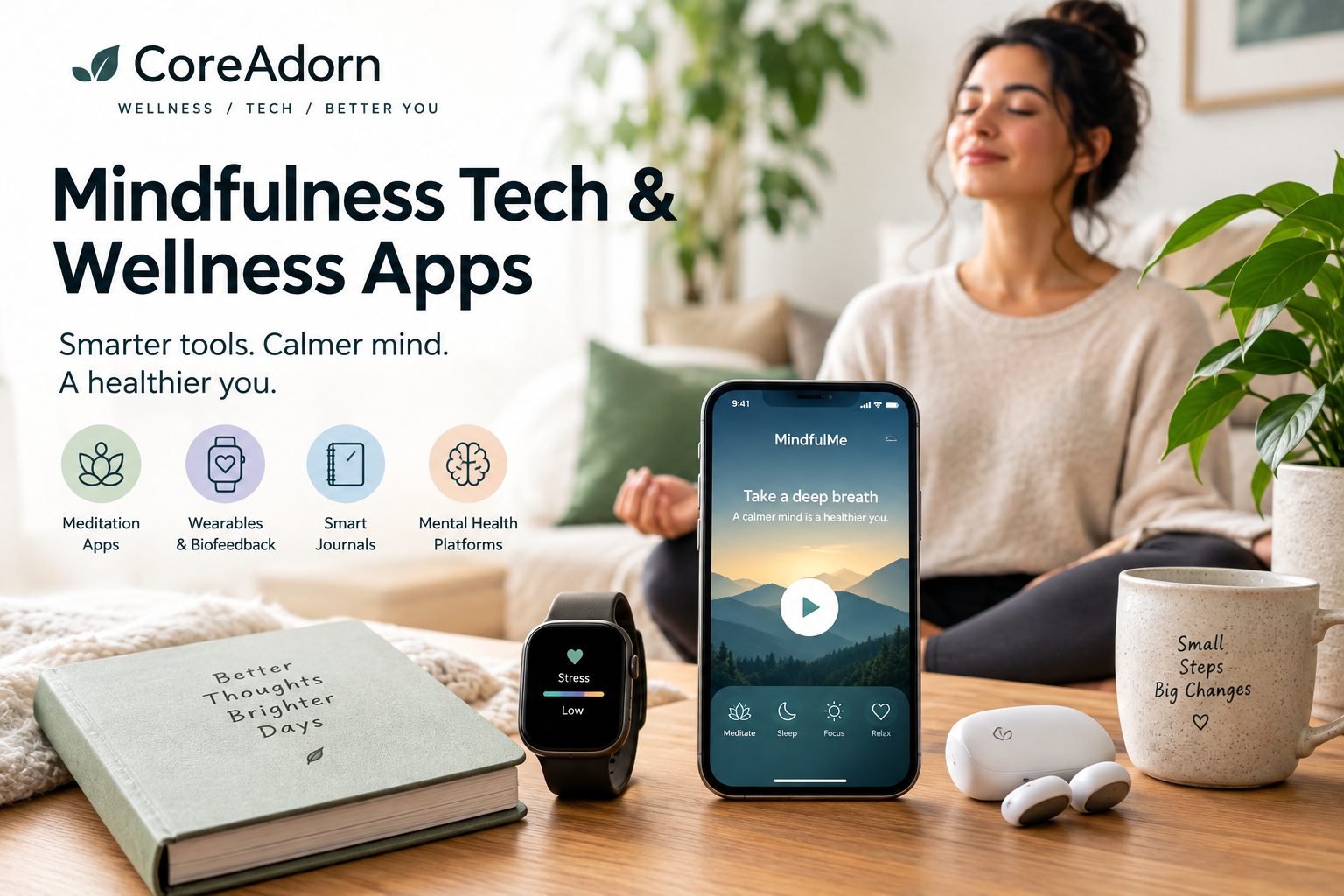
Looking for the best mindfulness tech or wellness app? U.S. shoppers can choose from meditation apps, smartwatches, stress-tracking wearables, biofeedback devices, digital journals, and mental wellness platforms.
The right choice depends on what you want to improve, how often you will use it, and whether you are comfortable paying a monthly or yearly subscription.
Affiliate disclosure: Some links on this page may be affiliate links. If you buy through one of these links, CoreAdorn may earn a commission at no extra cost to you.
Quick Answer: What Is the Best Mindfulness Tech?
For most beginners, a guided meditation app is the easiest and least expensive way to start. U.S. buyers who want sleep, heart-rate, recovery, or stress data may prefer a smart wearable , while people who prefer writing may get more value from a digital journal .
- Best for beginners: Guided meditation apps
- Best for meditation and sleep: Meditation and sleep apps
- Best for stress and health tracking: Smart wearables
- Best for breathing feedback: Biofeedback devices
- Best for reflection: Digital journals
- Best for several wellness services: Mental wellness platforms
- Best low-cost option: Free or low-cost meditation apps
What Is Mindfulness Technology?
Mindfulness technology includes apps and connected devices designed to support meditation, breathing exercises, journaling, sleep routines, stress awareness, and other wellness habits.
Common examples include:
- Meditation apps
- Breathing apps
- Smartwatches
- Fitness trackers
- Stress-monitoring wearables
- Biofeedback devices
- Sleep trackers
- Digital journals
- AI journaling apps
- Mental wellness platforms
For U.S. consumers, these products range from free smartphone apps to premium devices costing several hundred dollars.
The best product is not necessarily the one with the most features. It is the one that fits the habit you want to build.
Best Mindfulness Tech for U.S. Buyers
There are four main categories worth comparing before you spend money:
- Guided meditation apps
- Smart wearables and biofeedback devices
- Digital and AI journals
- Mental wellness platforms
Each serves a different purpose.
When you buy through links on our site, we may earn an affiliate commission at no extra cost to you. This helps support our work.
Guided Meditation Apps
Guided meditation apps are often the best starting point for people who are new to mindfulness.
Instead of trying to meditate without instructions, you can choose a session and follow an instructor through breathing, meditation, relaxation, or body-awareness exercises.
Popular app features may include:
- Guided meditation
- Breathing exercises
- Sleep content
- Relaxation sessions
- Focus exercises
- Stress-management programs
- Beginner courses
- Short five-minute sessions
- Longer guided sessions
- Progress tracking
What Should You Look for in a Meditation App?
Do not choose an app simply because it has thousands of sessions.
For U.S. buyers, compare:
- Free plan
- Free trial
- Monthly price
- Annual price
- Family plans
- Session length
- Instructor quality
- Sleep content
- Offline listening
- Device compatibility
- App ratings
- Privacy policy
- Cancellation process
A five-minute meditation you actually use can be more useful than a huge library you never open.
Who Should Buy a Meditation App?
A guided meditation app may be a good choice if you:
- Are new to meditation
- Want step-by-step guidance
- Prefer audio instructions
- Want short daily sessions
- Want meditation for relaxation or sleep
- Do not want to buy another device
Are Meditation Apps Effective?
Research suggests that mindfulness and meditation programs delivered through digital platforms may help with stress and some mental health symptoms for certain users. The level of benefit varies by person, program, and study.
Digital Journals and AI Journaling Apps
Meditation is not the only way to practice mindfulness.
Some people prefer writing about their day, thoughts, emotions, goals, and habits.
Digital journals can add features that are difficult to get from a traditional notebook.
These may include:
- Daily prompts
- Mood tracking
- Habit tracking
- Voice-to-text
- Search
- Reminders
- Cloud backup
- Data export
- Password protection
- AI-generated reflection prompts
What Makes a Good Digital Journal?
For U.S. buyers, look beyond the interface.
- Privacy controls
- Encryption
- Data storage
- Export options
- Account deletion
- AI data use
- Third-party data sharing
- Subscription cost
Are AI Journaling Apps Private?
Privacy depends on the individual service.
Your journal may contain sensitive personal information, so check the company's privacy policy before using an AI-powered journal.
Look for information about:
- Where your entries are stored
- Whether your data is used for AI training
- Third-party access
- Data retention
- Account deletion
- Data downloads
Do not assume that an AI journal has the same privacy protections as a healthcare provider.
Mental Wellness Apps and Platforms
Mental wellness platforms combine multiple services into one product.
Depending on the provider, you may find:
- Meditation
- Sleep programs
- Breathing exercises
- Mindfulness courses
- Mood tracking
- Coaching
- Therapy services
- Educational content
This can be convenient if you want more than a meditation app.
What Should You Check Before Subscribing?
Read the service description carefully.
- Does it provide meditation or clinical care?
- Are licensed professionals involved?
- Does it offer therapy?
- Is coaching included?
- Are appointments included?
- Does insurance apply?
- Is messaging included?
- What does the subscription cover?
- How easy is cancellation?
- How does the company handle personal information?
Can a Wellness App Replace Therapy?
No.
Mindfulness and wellness apps can support everyday wellness habits, but they should not be treated as a replacement for professional mental health care.
If symptoms are affecting your daily life, work, relationships, or sleep, consider speaking with a qualified healthcare or mental health professional.
Mindfulness Apps vs. Wearables
The better choice depends on what you want from the product.
| Feature | Meditation App | Smart Wearable |
|---|---|---|
| Guided meditation | Yes | Sometimes |
| Breathing exercises | Usually | Sometimes |
| Sleep tracking | Sometimes | Usually |
| Heart-rate tracking | No / Limited | Usually |
| Stress estimates | Limited | Often |
| Fitness tracking | Limited | Usually |
| Upfront cost | Low | Medium to High |
| Subscription | Sometimes | Sometimes |
| Extra hardware | No | Yes |
| Best for beginners | Yes | Depends |
Choose a Meditation App If You Want:
- Guided sessions
- Low upfront cost
- Simple setup
- Audio meditation
- Sleep content
- Beginner programs
Choose a Wearable If You Want:
- Health trends
- Sleep tracking
- Heart-rate information
- Stress estimates
- Fitness tracking
- Passive data collection
How Much Does Mindfulness Technology Cost?
Prices vary widely across the U.S. market.
Free to $20
You can find:
- Free meditation apps
- Basic meditation timers
- Simple digital journals
- Free breathing tools
$20 to $100
This range can include:
- Premium app subscriptions
- Advanced journal apps
- Some entry-level wellness products
$100 to $300
This range includes some:
- Fitness trackers
- Wellness devices
- Biofeedback products
- Entry-level smartwatches
$300 and Above
Premium smartwatches and advanced health wearables often fall into this range.
Remember that a premium smartwatch usually does much more than mindfulness tracking.
If meditation is your only goal, buying a $400+ smartwatch may not make financial sense.
Do Mindfulness Apps Require a Subscription?
Not always.
Some apps offer free meditation sessions, while others put most of their content behind a monthly or annual subscription.
Before subscribing, check:
- Monthly price
- Annual price
- Free trial
- Automatic renewal
- Cancellation policy
- Family plan
- Offline access
- Features available after cancellation
Calculate the Long-Term Cost
Do not look only at the advertised monthly price.
Use:
Device price + subscription fees = total ownership cost
For example, if a device costs $250 and its premium service costs $10 per month, the two-year cost would be:
$250 + ($10 × 24) = $490
This gives you a better idea of what you are actually spending.
Privacy and Wellness Apps: What U.S. Buyers Should Know
Wellness apps can collect information that is more personal than data collected by ordinary shopping apps.
Depending on the service, this can include:
- Sleep data
- Heart-rate information
- Mood information
- Journal entries
- Voice recordings
- Activity data
- Device information
- Location data
Before creating an account, review the privacy policy.
Look for information about:
- Data sharing
- Advertising
- Third-party analytics
- AI processing
- Data retention
- Account deletion
- Data downloads
- Encryption
How to Choose the Best Wellness App for You
Use your goal as the starting point.
| Your Goal | Best Option |
|---|---|
| Learn meditation | Guided meditation app |
| Reduce everyday stress | Meditation or breathing app |
| Improve bedtime routine | Meditation or sleep app |
| Track sleep | Smart wearable |
| Monitor stress trends | Smart wearable |
| Practice breathing with feedback | Biofeedback device |
| Reflect on your day | Digital journal |
| Use guided reflection | Smart or AI journal |
| Combine several services | Mental wellness platform |
You do not need several subscriptions.
Start with one product that solves one problem.
7 Questions to Ask Before Buying Mindfulness Tech
1. What problem does this product solve?
Do not buy a product simply because it has an impressive feature list.
2. Will I actually use it?
A simple app that fits your routine can beat a premium device that stays unused.
3. Is there a free trial?
Try the service before committing to a yearly subscription when possible.
4. What is the total cost?
Include hardware, subscriptions, accessories, and renewal fees.
5. What happens to my data?
Read the privacy policy before entering journal or health information.
6. Does it work with my phone?
Check iPhone and Android compatibility before purchasing.
7. Can I cancel easily?
Look at the cancellation terms before starting a free trial.
How to Build a Simple Mindfulness Routine
You do not need a complicated routine.
Morning: 5 Minutes
Use a short guided meditation or breathing session.
During the Day: 1 - 2 Minutes
Take a short break when you notice tension or distraction.
Evening: 5 Minutes
Write down:
- How you felt
- What caused stress
- What went well
- What you want to focus on tomorrow
Before Bed
Use a short relaxation or meditation session if you find it helpful.
Keep unnecessary phone notifications off. Your wellness app should not become another source of distraction.
Are Mindfulness Apps Worth It?
They can be.
The value depends on how often you use the service and whether its features match your needs.
A $10-per-month meditation app that you use several times a week may provide more value than a $500 wearable that spends most of its time unused.
Before buying, consider:
- Your goal
- Usage frequency
- Subscription cost
- Free trial
- Privacy
- Device compatibility
- Return policy
- Long-term cost
Buy for the habit you want to build, not for the longest feature list.
Frequently Asked Questions About Mindfulness Tech
What is the best mindfulness app for beginners?
The best mindfulness app for beginners usually has short guided sessions, clear instructions, beginner programs, and a free trial or free plan. Start with five to ten minutes a day and choose an app you are likely to keep using.
Are mindfulness apps effective?
Research suggests mindfulness and meditation apps may help some people with stress, anxiety symptoms, and general well-being. Results vary, and these apps should not replace professional mental health treatment.
[Insert Link/Citation: Peer-reviewed systematic review of mindfulness mobile applications]
Can a smartwatch detect stress?
Some smartwatches estimate stress using physiological signals such as heart rate and heart-rate variability. These measurements are estimates and can be affected by exercise, caffeine, sleep, illness, and other factors.
[Insert Link/Citation: Independent study on wearable stress measurement]
Are wellness apps safe?
Wellness apps can be useful, but buyers should review their health claims, privacy policies, data practices, and subscription terms. App-based measurements should not be treated as a medical diagnosis.
Final Takeaway
The best mindfulness technology is the product you will actually use.
For most U.S. beginners, a guided meditation app is the easiest place to start. Choose a smart wearable if you want sleep and health trends, a biofeedback device if you want physiological feedback, or a digital journal if writing fits your routine better.
Before buying, compare the features, subscription fees, privacy policy, compatibility, return policy, and total long-term cost.
Start with one product and one simple habit.
Ready to try mindfulness technology? Choose the tool that matches your goal, try it consistently for a few weeks, and see whether it earns a place in your daily routine.
Already use a meditation app, smartwatch, or wellness device? Share your experience in the comments.
CoreAdorn is reader-supported. When you buy through links on our site, we may earn an affiliate commission.
0 Comments
Be the first to comment.
Leave a comment
Please use kind words and keep your comment on topic. Comments are reviewed by the CoreAdorn team before they appear.