
The Ultimate Guide to Houseplant Light Requirements: Decoding Your Home's Natural Light
Learn how to identify the right light for your houseplants with this practical guide to north, south, east, and west-facing windows. Discover how to distinguish direct from indirect light, measure light with simple tests and lux meters, spot signs of too much or too little light, and choose the best location for healthier indoor plants.
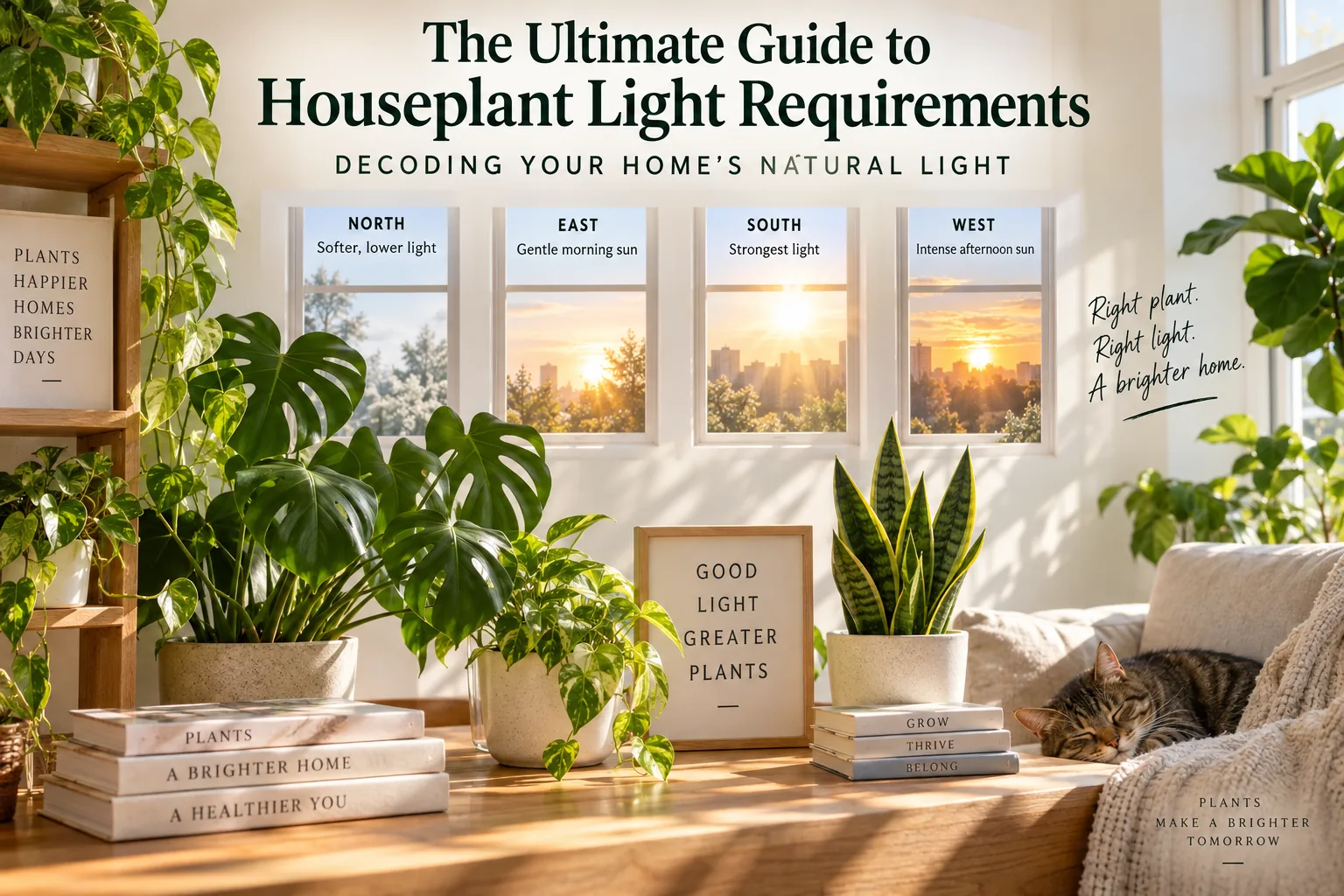
Guessing your home's light level is one of the fastest ways to kill a houseplant. A plant placed in a bright-looking room can still receive too little usable light, while a plant sitting beside a sunny window can develop bleached or scorched leaves.
The key is to understand how much light reaches the actual leaves, how that light changes during the day, and whether the plant needs direct sun, bright indirect light, or lower light conditions. Window direction, distance from glass, curtains, trees, neighboring buildings, and seasonal changes all matter.
Quick Answer: Direct light means sunlight reaches the plant's leaves without being significantly filtered or reflected first, while indirect light is bright ambient light that reaches the plant after bouncing around the room or passing through a sheer curtain. Most popular houseplants prefer bright indirect light, although succulents, cacti, and some flowering plants can need several hours of direct sun.
Why Houseplant Light Requirements Matter
Light is the energy source that allows plants to photosynthesize, so getting the light level right is more important than simply choosing a "bright" room. Water and fertilizer cannot compensate for a plant that consistently receives inadequate light.
A plant may survive for months in poor lighting while gradually becoming weaker. Slow growth, small new leaves, faded coloring, and long gaps between leaves can appear before the plant looks obviously unhealthy.
Different species also have very different tolerances. A pothos may handle a relatively dim corner, while a fiddle leaf fig generally needs considerably more usable light.
If you're growing a fiddle leaf fig, our Ultimate Fiddle Leaf Fig Care Guide covers its specific light, watering, soil, and maintenance requirements.
When you buy through links on our site, we may earn an affiliate commission at no extra cost to you. This helps support our work.
Direct vs. Indirect Light
Direct light occurs when sunlight travels from the window to the plant without substantial obstruction. You can usually see a defined shadow from the plant on the floor or wall when the sun is hitting it.
Indirect light is bright light that reaches the plant without strong, direct sunbeams hitting its leaves. This can happen when the plant sits several feet from a window, receives reflected daylight, or is protected by sheer curtains .
A useful distinction is that "indirect" does not necessarily mean "low." A plant several feet from a large unobstructed south-facing window may receive very bright indirect light.
The U.S. Window Direction Compass
Window direction gives you a useful starting point for estimating indoor light, but the actual intensity depends on latitude, season, obstructions, window size, and how far the plant sits from the glass.
For a typical U.S. home, the four primary window orientations behave differently throughout the day.
North-Facing Windows
North-facing windows generally provide the lowest-intensity natural light and little or no strong direct sunlight.
They can work well for plants that tolerate lower light, especially when the window is large and unobstructed.
Expect softer daylight and more pronounced North-facing shadows . Plants positioned several feet away may receive considerably less light than plants directly beside the glass.
Good candidates can include:
- Snake plants
- ZZ plants
- Pothos
- Heartleaf philodendrons
- Cast iron plants
Variegated plants may need more light than their green counterparts to maintain strong coloration.
South-Facing Windows
South-facing windows usually provide the strongest overall indoor light exposure in the Northern Hemisphere.
The sun can remain visible through much of the day, creating substantial intensity near the glass. This makes south-facing windows useful for sun-loving houseplants, but it also increases the risk of leaf scorch.
South-facing window intensity can be particularly strong during summer. A plant immediately beside the glass may receive much more light than the same plant positioned 4 or 6 feet away.
Use sheer curtains when necessary, especially for species that prefer bright indirect light rather than intense afternoon sun.
East-Facing Windows
East-facing windows typically provide gentle direct morning sunlight followed by bright indirect light later in the day.
Morning sunlight is generally less intense than strong afternoon exposure, making an east-facing window a versatile location for many houseplants.
This orientation can work particularly well for plants that appreciate good light but may struggle with harsh afternoon sun.
Consider east-facing exposure for:
- Monstera
- Peperomia
- Prayer plants
- Orchids
- Many tropical foliage plants
West-Facing Windows
West-facing windows receive strong afternoon and evening sunlight, which can be considerably more intense than morning light.
This orientation can provide excellent light for high-light plants, but the heat and intensity near the glass can cause problems for sensitive foliage.
A plant that looks perfectly healthy several feet from a west-facing window may develop scorched leaves when moved directly against the glass.
Sheer curtains can soften the exposure without making the room excessively dark.
Houseplant Light by Window Direction
Each window orientation creates a different combination of intensity, duration, and timing, so use direction as a starting point rather than an absolute rule.
| Window Direction | Common Concern | Plants That May Work Well |
|---|---|---|
| North | Insufficient intensity | ZZ plant, snake plant, pothos |
| South | Sunburn and overheating | Succulents, aloe, jade |
| East | Usually fewer intensity problems | Monstera, orchids, peperomia |
| West | Leaf scorch and heat | High-light tropicals, succulents |
These are general guidelines rather than guarantees. A south-facing window blocked by a neighboring building may provide less usable light than an unobstructed east-facing window.
How Far Should a Plant Be From a Window?
Distance from the window can change light intensity dramatically, so moving a plant only a few feet can make a meaningful difference.
As a practical starting point:
- High-light plants often perform best within about 1–3 feet of a bright window.
- Bright-indirect-light plants may work around 2–6 feet from a suitable window.
- Lower-light plants can sometimes tolerate positions farther from windows.
These ranges are not universal. Window size, glass type, curtains, outdoor shade, season, and geographic location all affect the result.
Measuring Your Houseplant's Light
You can estimate indoor light without expensive equipment by using a hand-shadow test or a smartphone light-meter app.
Neither method replaces professional horticultural measurements, but both can help you identify obvious differences between locations.
Method 1: The Hand-Shadow Test
A sharp, clearly defined hand shadow usually indicates stronger light, while a faint or barely visible shadow suggests lower light.
Place your hand approximately 12 inches above the location where the plant will sit.
Look at the shadow on a nearby surface.
A strong, crisp shadow suggests relatively intense light. A soft shadow indicates moderate or indirect light. If you can barely see a shadow, the location may be too dim for plants with high light requirements.
Perform the test at different times of day. A west-facing window might look moderate at noon but become dramatically brighter later in the afternoon.
Method 2: Use a Smartphone Light-Meter App
A smartphone light-meter app can provide a more useful numerical comparison between different locations in your home.
Look for apps that report illumination in lux . Your phone's light sensor is not a professional horticultural meter, but it can still help you compare one location with another.
Take readings:
- Directly beside the window.
- About 2 feet from the window.
- About 4 feet from the window.
- At the plant's current location.
Repeat the measurements at different times.
The goal isn't to chase one perfect number. You are trying to understand how dramatically the available light changes throughout your room.
Understanding Lux for Houseplants
Lux measures visible light intensity, but lux alone does not tell you exactly how much usable light a plant receives for photosynthesis.
This distinction matters because plants respond to light differently than human eyes do.
A room can appear bright to you while still providing inadequate light for a high-light plant. Human vision automatically adjusts to different brightness levels, making visual judgment surprisingly unreliable.
For serious indoor growing, measurements such as PPFD and daily light integral (DLI) provide more plant-specific information than lux. For ordinary houseplant placement, however, comparing lux readings between different parts of your home can still be useful.
Signs Your Plant Is Getting Too Much Light
Bleached, pale, crispy, or brown patches on leaves can indicate excessive light exposure, particularly when they appear on surfaces facing the window.
Watch for:
- Pale or bleached areas
- Tan or brown patches
- Crispy leaf sections
- Damage concentrated on window-facing leaves
- Sudden discoloration after moving a plant into stronger light
If scorching appears, move the plant farther from the window or filter the sunlight with a sheer curtain.
Signs Your Plant Is Getting Too Little Light
Leggy growth is one of the clearest signs that a plant is stretching toward a stronger light source.
You may notice:
- Long gaps between leaves
- Thin or weak stems
- Smaller new leaves
- Slow growth
- Leaves turning toward the window
- Loss of variegation
- Pale or dull foliage
- Soil staying wet for unusually long periods
When light is insufficient, photosynthesis and growth can slow. The plant may use water more slowly, leaving the soil wet for longer than expected.
For a deeper look at how light and moisture work together, see our Houseplant Watering Masterclass .
What Is Phototropism?
Phototropism is the tendency of plant growth to respond to the direction of light, which is why houseplants often lean toward windows.
A plant placed in one position may gradually bend its stems toward the strongest light source.
Rotating the pot periodically can help maintain more balanced growth, although the ideal frequency depends on the species and growing conditions.
If a plant constantly stretches toward a window despite regular rotation, the bigger issue may be insufficient light rather than uneven rotation.
How Curtains Affect Houseplant Light
Sheer curtains reduce the intensity of sunlight while still allowing substantial daylight to reach the plant.
This can be useful near south- and west-facing windows where direct sunlight becomes too intense.
Heavy curtains and blackout shades are different. They can reduce available light dramatically and may turn an otherwise suitable location into a low-light environment.
If a plant sits behind a curtain, measure the light where the leaves actually grow rather than at the window.
How Seasons Change Indoor Light
A houseplant's light conditions can change substantially throughout the year, even when it stays in the same location.
The sun's position changes with the seasons, and the number of daylight hours changes as well.
Trees can also make a difference. A window that receives strong sunlight during winter may become shaded by a tree once its leaves return in spring.
This is one reason a plant can thrive in one season and struggle in another without any change in watering or fertilizer.
What to Do When Your Home Does Not Have Enough Natural Light
A grow light is the most practical solution when your home's natural light cannot meet a plant's requirements.
Modern LED grow lights can provide consistent supplemental lighting without requiring a sunny window.
Place the light close enough to provide useful intensity while following the manufacturer's recommended distance. A light that looks extremely bright to your eyes may still provide inadequate intensity several feet away.
For plants with demanding light requirements, consider:
- LED grow bulbs
- Full-spectrum LED grow lights
- Clamp-mounted grow lights
- Adjustable grow-light panels
- Timers for consistent daily exposure
Consistency matters. A grow light used randomly for a few hours here and there is less useful than a predictable lighting schedule.
Match the Plant to the Window
The easiest way to manage houseplant light is to choose plants according to the conditions you already have rather than forcing every plant into the same location.
Low-Light Locations
Consider plants such as:
- ZZ plant
- Snake plant
- Cast iron plant
- Pothos
- Heartleaf philodendron
Remember that low-light tolerance does not mean a plant can thrive in darkness.
Bright Indirect Light
Consider:
- Monstera
- Rubber plant
- Peperomia
- Many orchids
- Philodendrons
- Certain calatheas
These plants generally benefit from strong ambient daylight without prolonged harsh direct sun.
High-Light Locations
Consider:
- Cacti
- Many succulents
- Aloe vera
- Jade plants
- Some citrus plants
- Certain flowering species
These plants generally require stronger exposure and may struggle in dim rooms.
The Most Common Houseplant Light Mistake
The biggest mistake is judging light by how bright a room looks to human eyes instead of measuring the light where the plant actually sits.
A bright-looking living room can still have surprisingly low light several feet away from its windows.
Another common mistake is assuming all indirect light is equivalent. Indirect light beside a large south-facing window can be vastly brighter than indirect light in a north-facing corner.
Think about intensity, duration, direction, and distance rather than using only labels such as "bright room."
Connect Light With the Rest of Your Plant Care
Light affects watering, growth, fertilizer needs, and overall plant health, so it should be considered as part of a complete indoor plant-care routine.
A plant receiving strong light may use water faster than the same species in a dim room. A plant receiving inadequate light may grow slowly and keep its soil wet for longer.
For the complete foundation of choosing, growing, and caring for indoor plants, visit our pillar guide, Indoor Plants and Houseplants: What You Need to Know .
Quick Houseplant Light Checklist
Before choosing a permanent location, check these factors:
- Identify the window direction.
- Observe the room during different parts of the day.
- Check whether buildings or trees block sunlight.
- Measure light where the plant will actually sit.
- Look for strong or weak shadows.
- Consider using a smartphone lux meter for comparisons.
- Watch for stretching and leaning.
- Watch for bleached or scorched foliage.
- Use sheer curtains when direct sun is excessive.
- Consider grow lights when natural light is consistently inadequate.
- Reassess conditions as the seasons change.
Summary: Find Your Home's Best Plant Window
The right houseplant location depends on the amount, intensity, duration, and direction of light reaching the leaves - not simply how bright the room appears.
Start with your main living room window. Which direction does it face: north, south, east, or west?
Once you know that, observe the sunlight throughout the day and check the actual spot where you want to place your plants. That simple process can prevent sunburn, leggy growth, slow growth, and many of the problems commonly blamed on watering.
The goal isn't to find the brightest spot in your home. It's to find the right light for the specific plant .
CoreAdorn is reader-supported. When you buy through links on our site, we may earn an affiliate commission.
0 Comments
Be the first to comment.
Leave a comment
Please use kind words and keep your comment on topic. Comments are reviewed by the CoreAdorn team before they appear.