
Sleep Optimization: Evidence-Based Ways to Sleep Better and Support Mental Wellness
Sleep optimization and mental wellness are closely connected. Poor sleep can affect memory, concentration, emotional regulation, and daily performance. This guide explains how sleep architecture, HRV, circadian rhythm alignment, bedroom conditions, evening relaxation, and morning light exposure influence better rest. Discover practical, evidence-based strategies and a simple daily sleep hygiene checklist to improve sleep quality, support mental resilience, and build healthier long-term sleep habits.
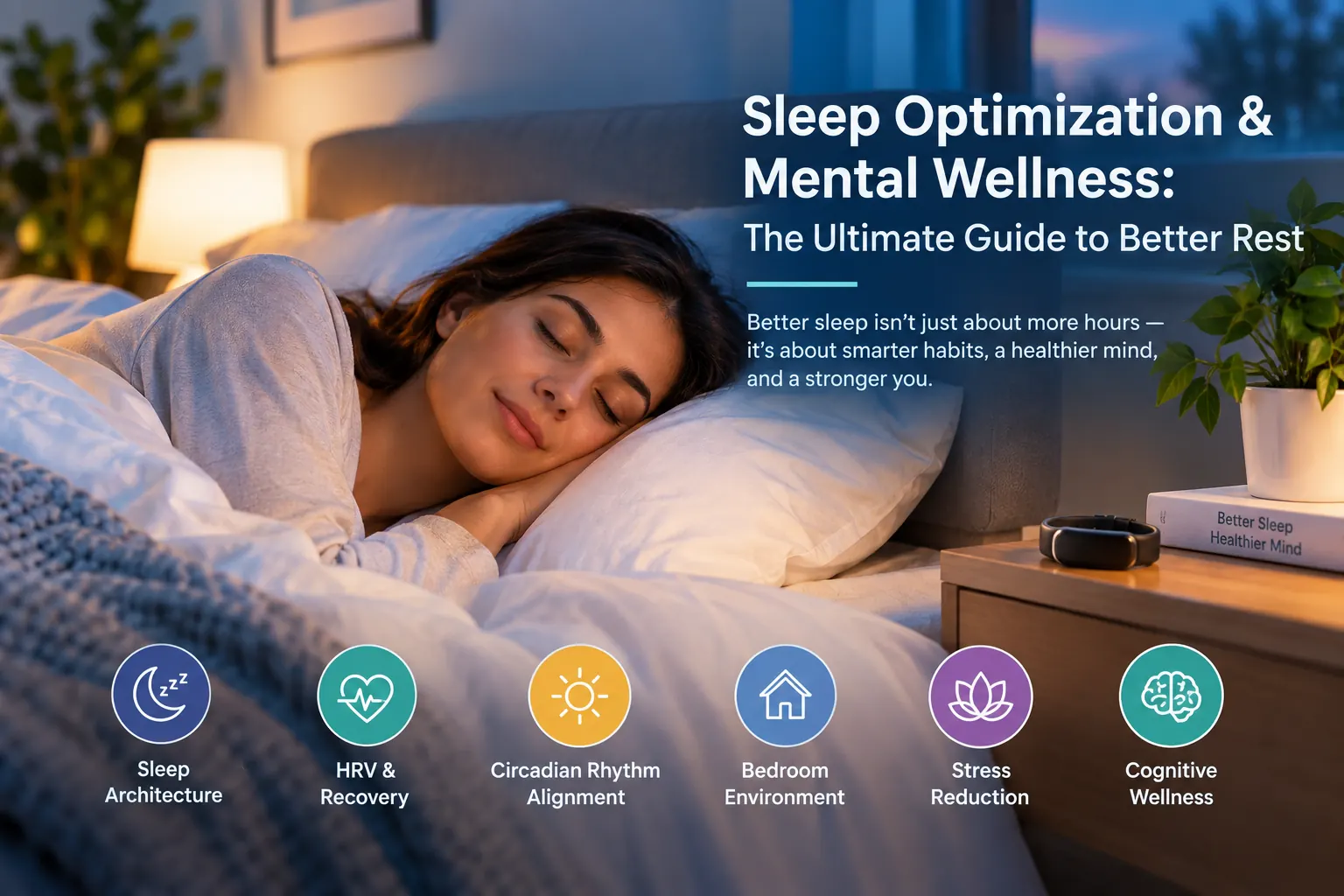
Better sleep is not about finding one perfect sleep hack. Sleep quality is influenced by your sleep schedule, daily light exposure, bedroom environment, evening habits, stress levels, and - when useful - sleep tracking data.
Quick Answer: What Is Sleep Optimization?
Sleep optimization is the process of improving the habits, schedule, environment, and behaviors that influence sleep quality. The most useful strategies include getting at least 7 hours of sleep for most adults, maintaining a consistent sleep schedule, getting appropriate daytime light exposure, keeping the bedroom comfortable and dark, limiting caffeine and alcohol close to bedtime, and using relaxation techniques to reduce nighttime stress.
For most healthy adults, sleep optimization starts with a simple foundation: get enough sleep, keep your sleep and wake times reasonably consistent, create a comfortable and dark bedroom, reduce stimulating activities before bed, and pay attention to habits that repeatedly interfere with sleep.
Sleep Optimization at a Glance
| Area | What to Focus On |
|---|---|
| Sleep duration | Aim for at least 7 hours for most adults. |
| Sleep schedule | Keep bedtime and wake time reasonably consistent. |
| Morning light | Get appropriate daytime light exposure to support your body clock. |
| Bedroom | Keep the room comfortable, quiet, and dark. |
| Evening routine | Allow time to wind down before attempting to sleep. |
| Caffeine | Avoid caffeine late in the day if it interferes with sleep. |
| Alcohol | Do not rely on alcohol as a sleep aid; it can disrupt sleep. |
| Sleep tracking | Use wearable data to identify trends rather than diagnose sleep disorders. |
| Stress | Use relaxation techniques to reduce mental stimulation before bed. |
When you buy through links on our site, we may earn an affiliate commission at no extra cost to you. This helps support our work.
What Is Sleep Optimization?
Sleep optimization means improving the conditions and habits that make healthy sleep easier. It is broader than simply going to bed earlier.
A practical sleep-optimization approach looks at several connected factors:
- How long you sleep
- When you sleep and wake
- Your exposure to light during the day and evening
- Your bedroom temperature, noise, and darkness
- Caffeine, alcohol, food, and exercise habits
- Stress and mental stimulation before bed
- Patterns in your sleep and daytime energy
The goal is not to achieve a perfect sleep score every night. The goal is to create repeatable habits that support good sleep over time.
How Sleep Affects Mental Health and Cognitive Performance
Sleep and mental health influence each other. Poor sleep can make it harder to regulate emotions, concentrate, and manage everyday stress. At the same time, stress and anxiety can make it more difficult to fall asleep or stay asleep.
This can create a cycle:
Poor sleep -> greater fatigue and stress -> harder emotional regulation -> increased difficulty sleeping.
Improving sleep does not solve every mental-health problem, but better sleep can be an important part of a broader approach to physical and mental well-being.
Understanding Sleep Stages: Deep Sleep and REM Sleep
Sleep is not one uniform state. During a normal night, the brain moves through different stages of non-REM and REM sleep.
Deep Sleep
Deep sleep, sometimes called slow-wave sleep, is a stage of non-REM sleep associated with physical restoration and important biological processes.
Rather than trying to maximize one specific sleep stage, focus on getting enough total sleep and maintaining habits that support healthy sleep architecture.
REM Sleep
REM sleep is characterized by increased brain activity and is associated with dreaming, memory processing, and emotional functions.
Both non-REM and REM sleep are normal parts of healthy sleep. Shortening your total sleep time to chase a specific amount of "deep sleep" is generally not a useful optimization strategy.
Why Better Sleep Matters for Cognitive Performance
Adequate sleep supports everyday cognitive functions such as:
- Attention and concentration
- Learning and memory
- Decision-making
- Reaction time
- Emotional regulation
If you regularly feel mentally tired despite spending enough time in bed, look beyond sleep duration. Your schedule, sleep quality, stress, medications, alcohol intake, caffeine use, or an underlying sleep disorder may also play a role.
Can Sleep Trackers Help You Understand Your Sleep?
Sleep trackers can be useful for identifying patterns. Depending on the device, they may estimate metrics such as:
- Total sleep time
- Time in bed
- Sleep and wake timing
- Sleep efficiency
- Heart rate
- Heart-rate variability (HRV)
- Estimated sleep stages
The important word is estimate . Consumer wearables do not measure sleep in exactly the same way as a clinical sleep study.
Research comparing consumer wrist-worn sleep trackers with polysomnography - the clinical reference method for measuring sleep - has found meaningful differences in several sleep measurements.
How to Use Sleep-Tracking Data
Use wearable data to identify trends , not to diagnose yourself. For example, if your sleep duration consistently falls after late caffeine use, frequent travel, or irregular bedtimes, that pattern may be useful.
A single night's sleep score should not determine whether you had a "good" or "bad" night.
For readers interested in wearable technology, see our guide: 5 Best Sleep Tracking Wearables for Deep Sleep Optimization .
What Is HRV and Why Do Sleep Trackers Measure It?
Heart-rate variability (HRV) describes changes in the time interval between heartbeats. Wearables often use HRV as one of several signals to estimate recovery or physiological stress.
HRV naturally varies between people and can also change because of exercise, illness, stress, alcohol, sleep, and other factors.
Because of this variability, an HRV value should be interpreted in context rather than treated as a standalone measure of health or sleep quality.
How to Create a Better Bedroom Environment for Sleep
Your bedroom does not need to look like a high-tech sleep laboratory. The most useful changes are often simple: make the room comfortable, reduce unwanted noise and light, and choose bedding that helps you maintain a comfortable temperature.
Keep the Bedroom Comfortable and Cool
A bedroom that feels too hot or too cold can make it harder to sleep comfortably. There is no single temperature that works for everyone, so prioritize a cool, comfortable sleeping environment.
Reduce Unwanted Noise
Traffic, neighbors, appliances, pets, and other unpredictable sounds can interfere with sleep.
Depending on your situation, useful options may include:
- Earplugs
- White-noise machines
- Fans
- Quieter bedroom equipment
- Sound-dampening measures
Keep the Bedroom Dark
A dark sleeping environment can reduce unwanted visual stimulation. Consider blackout curtains, blinds, or an eye mask if outside light enters the room.
Reduce Bright Light in the Evening
Light is an important signal for the body's circadian system. Bright light during the day can support alertness and circadian timing, while reducing unnecessary bright light late in the evening can make it easier to transition toward sleep.
You do not necessarily need to eliminate every source of blue light. A more practical approach is to reduce bright and stimulating light as bedtime approaches.
For a more detailed bedroom setup, see: How to Build a Sleep Optimization Environment: Best Bedroom Gear .
How to Relax Before Bed and Reduce Nighttime Stress
One of the biggest obstacles to falling asleep is going to bed while your mind is still actively working.
A simple wind-down period can help create a clear transition between daytime activity and sleep.
Try a 30 - 60 Minute Wind-Down Routine
About 30 - 60 minutes before bed, consider lowering the intensity of your activities. Your routine might include:
- Dim the lights.
- Put away work-related tasks.
- Reduce stimulating phone or computer activity.
- Take a warm shower or bath.
- Read a relaxing book.
- Try slow breathing or meditation.
- Prepare your bedroom for sleep.
Try Simple Breathing Exercises
Slow, comfortable breathing can be part of a relaxation routine. The objective is not to force yourself to fall asleep but to reduce mental and physical stimulation.
When Sleep Problems Need Medical Attention
Consider speaking with a healthcare professional if sleep problems are persistent or significantly affect daytime functioning.
Particular warning signs include loud habitual snoring, witnessed breathing pauses, persistent excessive daytime sleepiness, or repeated difficulty falling or staying asleep.
For ongoing insomnia, evidence-based behavioral treatment such as cognitive behavioral therapy for insomnia (CBT-I) may be recommended by healthcare professionals.
How to Align Your Sleep Schedule With Your Circadian Rhythm
Your circadian rhythm is an internal timing system that helps regulate the sleep-wake cycle. Light exposure is one of its strongest environmental signals.
Get Daytime Light
Getting natural or appropriately bright light during the day can provide a strong timing signal to the circadian system.
Morning light can be particularly useful for people trying to shift their sleep schedule earlier, although the effect depends on timing, intensity, duration, and individual circumstances.
Keep Bedtime and Wake Time Consistent
Try to maintain reasonably consistent sleep and wake times, including on weekends. Perfect consistency is not required, but large day-to-day changes can make your sleep schedule harder to maintain.
Watch Caffeine Timing
Caffeine can remain active for several hours. If caffeine affects your ability to fall asleep, experiment with moving your last caffeinated drink earlier in the day.
Be Careful With Alcohol as a Sleep Aid
Alcohol may make some people feel sleepy initially, but it can interfere with normal sleep later in the night. It should not be relied upon as a sleep treatment.
Daily Sleep Optimization Checklist
Morning
- Wake at approximately the same time each day.
- Get appropriate daylight exposure.
- Start your day with normal physical activity rather than remaining in bed.
Afternoon
- Keep physically active during the day.
- Avoid caffeine late in the day if it disrupts your sleep.
- Pay attention to excessive or unusually long naps.
Evening
- Reduce bright and stimulating light.
- Finish demanding work before your wind-down period.
- Use a relaxing pre-bed routine.
- Keep your bedroom comfortable and dark.
Weekly
- Review your sleep patterns rather than focusing on one night.
- Identify habits associated with better or worse sleep.
- Adjust one or two factors at a time.
A Simple 7-Day Sleep Optimization Plan
| Day | Focus |
|---|---|
| Day 1 | Choose a consistent wake-up time. |
| Day 2 | Improve daytime light exposure. |
| Day 3 | Make the bedroom darker and more comfortable. |
| Day 4 | Move caffeine earlier if it affects your sleep. |
| Day 5 | Create a 30 - 60 minute wind-down routine. |
| Day 6 | Review your sleep-tracking data or simple sleep diary. |
| Day 7 | Keep the habits that made the biggest practical difference. |
You do not need to change everything at once. A small number of consistent improvements are easier to maintain than an elaborate routine that lasts only a few days.
Sleep Optimization Products Worth Considering
Sleep products can make certain habits easier, but they should support - not replace - the fundamentals of healthy sleep.
| Product Category | What It Can Help With | What to Look For |
|---|---|---|
| Sleep tracker | Monitoring sleep and activity patterns | Comfort, battery life, useful trend reporting |
| Blackout curtains | Reducing bedroom light | Good light-blocking coverage |
| Cooling bedding | Improving temperature comfort | Breathable materials and suitable weight |
| White-noise machine | Masking unpredictable background noise | Simple controls and suitable sound options |
| Smart thermostat | Maintaining bedroom temperature | Reliable scheduling and easy controls |
| Sleep-focused lighting | Reducing bright evening light | Dimming and scheduling features |
| Relaxation tools | Supporting a calming bedtime routine | Simple, distraction-free operation |
The Bottom Line: Optimize the System, Not Just the Mattress
Sleep optimization works best when you treat sleep as a system rather than a single product or technique.
Start with the fundamentals:
- Get enough sleep.
- Keep your wake time reasonably consistent.
- Get appropriate light exposure during the day.
- Reduce unnecessary bright light at night.
- Keep your bedroom comfortable, quiet, and dark.
- Give yourself time to wind down.
- Limit caffeine or alcohol when they interfere with sleep.
- Use sleep-tracking technology as a tool for identifying trends - not as a diagnostic device.
Better sleep is not about achieving a perfect sleep score. It is about building habits that make good sleep more likely night after night.
Frequently Asked Questions About Sleep Optimization
What is the most important part of sleep optimization?
For most adults, the foundation is getting enough sleep on a regular schedule. The American Academy of Sleep Medicine and Sleep Research Society recommend that adults get at least 7 hours of sleep per night on a regular basis.
How many hours of sleep should adults get?
Most adults should regularly get at least 7 hours of sleep per night. Individual sleep needs vary, but regularly sleeping less than 7 hours is associated with inadequate sleep for many adults.
Does morning sunlight improve sleep?
Daytime light exposure provides an important signal to the circadian system. Appropriately timed morning light can help shift the body clock earlier in some circumstances, although the effect depends on timing, duration, intensity, and individual factors.
Should I completely avoid blue light before bed?
Complete elimination of blue light is not necessary for everyone. A more practical strategy is to reduce bright and stimulating light during the evening and keep the bedroom dark while sleeping.
Are smartwatch sleep stages accurate?
Consumer smartwatches and fitness trackers estimate sleep stages using sensors and algorithms. They can be useful for observing trends, but they are not equivalent to clinical polysomnography and should not be used to diagnose sleep disorders.
Is HRV a good measure of sleep quality?
HRV can provide useful information about physiological patterns, but it is not a standalone measure of sleep quality. HRV varies naturally and is affected by many factors, including stress, exercise, illness, alcohol, and sleep.
What temperature is best for sleeping?
There is no single temperature that works for everyone. A generally cool and comfortable bedroom is a practical starting point. Bedding, clothing, humidity, and individual temperature preferences also matter.
What should I do if I cannot fall asleep?
Avoid turning sleep into a performance test. Keep the environment comfortable, use a relaxing routine, and avoid repeatedly checking the clock. If difficulty falling or staying asleep happens regularly or affects your daytime functioning, discuss it with a healthcare professional.
Can sleep optimization improve mental wellness?
Better sleep can support emotional regulation, concentration, and daytime functioning. Sleep optimization should be considered one part of overall mental and physical wellness rather than a replacement for professional treatment when needed.
Sources and References
- Centers for Disease Control and Prevention (CDC), National Center for Health Statistics - Sleep duration and sleep difficulties among U.S. adults.
- American Academy of Sleep Medicine (AASM) and Sleep Research Society - Consensus recommendation on sleep duration for adults.
- Peer-reviewed research comparing consumer sleep-tracking devices with polysomnography.
- American Academy of Sleep Medicine - Circadian rhythm and light-treatment guidance.
- Peer-reviewed research on light exposure and circadian rhythm regulation.
Disclaimer
The information provided in this article is for general educational purposes only and should not be considered medical advice. Individual sleep needs and medical conditions vary. Consult a qualified healthcare professional for persistent or concerning sleep problems.
CoreAdorn is reader-supported. When you buy through links on our site, we may earn an affiliate commission.
0 Comments
Be the first to comment.
Leave a comment
Please use kind words and keep your comment on topic. Comments are reviewed by the CoreAdorn team before they appear.