
Sleep Trackers & Biometric Wearables: Best Devices for U.S. Buyers
Discover the best sleep trackers and biometric wearables for U.S. buyers. Compare smart rings, fitness trackers, screen-free sleep bands, and smart mattresses by sleep tracking features, HRV, heart rate, battery life, subscriptions, privacy, and price to find the right device for better sleep and recovery.
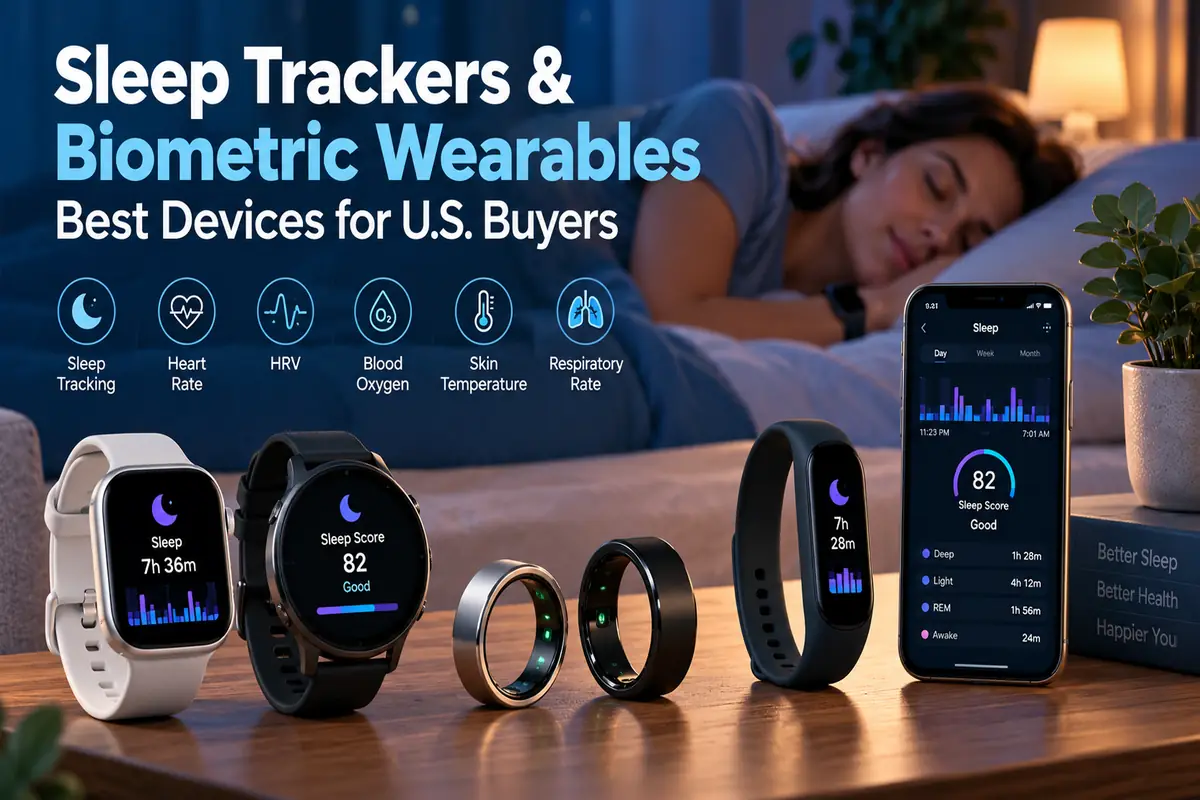
Want to know why you still feel tired after eight hours in bed?
A sleep tracker can help you spot patterns that are hard to notice on your own. Smart rings, fitness trackers, sleep bands, and smart mattresses can collect data about your sleep, heart rate, movement, temperature, and recovery.
For U.S. shoppers, the choice can be confusing. Some devices cost hundreds of dollars. Others add a monthly subscription. Some focus on sleep, while others combine sleep, fitness, workouts, and health data.
This guide breaks down what each type does, what you should look for, and where your money is best spent.
Quick Answer
Smart rings are one of the best choices for U.S. buyers who mainly want sleep and recovery tracking without wearing a smartwatch. Fitness trackers are better for people who want sleep, exercise, heart rate, and daily activity in one device. Sleep bands offer a simpler screen-free option, while smart mattresses and sleep systems focus on the bed and sleep environment.
- Best for sleep + recovery: Smart rings
- Best for sleep + fitness: Fitness trackers and smartwatches
- Best screen-free option: Sleep bands
- Best for couples: Smart mattresses and temperature-control systems
- Best for recovery data: Smart rings and advanced fitness wearables
- Best budget choice: Basic fitness trackers with sleep tracking
- Best for hands-off sleep tracking: Mattress and bed sensors
What Is a Sleep Tracker?
A sleep tracker is a device or app that collects information while you sleep.
Wearable devices may use movement sensors, optical heart-rate sensors, temperature sensors, and other biometric sensors. Software then uses those signals to estimate sleep duration, sleep stages, heart rate, recovery, and other metrics.
Popular options for U.S. consumers include:
- Smart rings
- Apple Watch-style smartwatches
- Fitness trackers
- Screen-free sleep bands
- Sleep-monitoring devices
- Smart mattresses
- Mattress sensors
- Sleep apps
The goal is not to collect the biggest pile of numbers. The goal is to find patterns you can use.
For example, you may discover that your sleep gets worse after late meals, alcohol, travel, hard evening workouts, or an inconsistent bedtime.
That information can help you change your routine.
When you buy through links on our site, we may earn an affiliate commission at no extra cost to you. This helps support our work.
Best Sleep Trackers for U.S. Buyers
There is no single sleep tracker that works for everyone.
Your best choice depends on four things:
- What you want to track
- How comfortable the device is
- How much you want to spend
- Whether you are willing to pay a subscription
Here are the main categories worth considering.
Best Smart Rings for Sleep
Smart rings have become popular with U.S. shoppers who want sleep and recovery information without sleeping with a watch.
They are small, lightweight, and have no large screen competing for attention at bedtime.
Depending on the model, a smart ring may track:
- Sleep duration
- Sleep timing
- Sleep stages
- Resting heart rate
- HRV
- Skin temperature
- Activity
- Recovery
- Breathing-related data
Some brands turn these measurements into daily sleep, readiness, or recovery scores.
Why Buy a Smart Ring?
A smart ring makes sense if you:
- Care more about sleep than smartwatch features
- Don't like wearing a watch to bed
- Want a screen-free device
- Want recovery information
- Prefer a small wearable
- Are comfortable paying for premium hardware or a subscription
What U.S. Buyers Should Check
Before buying, compare:
- Upfront price
- Monthly or annual subscription
- Battery life
- Ring sizing process
- Return period
- Warranty
- Replacement policy
- Sleep metrics
- HRV tracking
- Temperature tracking
- Water resistance
- iPhone compatibility
- Android compatibility
- Apple Health support
- Google Health Connect support
- Data privacy
- Data export options
Best for: U.S. shoppers who want detailed sleep and recovery data in a small, screen-free device.
Smart Ring Buying Tip
Do not compare smart rings by sensor count alone.
The app matters just as much.
A ring can collect plenty of data, but if the app makes that information difficult to understand, you may stop using it.
Best Fitness Trackers for Sleep and Recovery
If you want one device for your entire day, a fitness tracker or smartwatch can be a better purchase.
You can track sleep at night and then use the same device for:
- Steps
- Walking
- Running
- Cycling
- Gym workouts
- Heart rate
- GPS
- Calories
- Notifications
- Daily activity
This makes fitness trackers attractive to U.S. buyers who do not want separate devices for sleep and exercise.
What Should You Look For?
Check these features before buying:
- Sleep tracking
- Sleep-stage estimates
- Heart-rate monitoring
- HRV
- SpO2
- Battery life
- GPS
- Workout tracking
- Recovery features
- Phone compatibility
- App quality
- Subscription requirements
- Water resistance
- Comfort during sleep
Apple Watch, Fitbit, Garmin and Other Options
Different ecosystems work better for different buyers.
If you already use an iPhone, check how well the device works with Apple Health.
Android users should check compatibility with their phone and health-data apps.
If you already own a smartwatch, look at its sleep features before buying another tracker. You may already have enough information for your needs.
Best for: Buyers who want sleep, fitness, heart rate, workouts, and daily activity in one device.
Best Screen-Free Sleep Bands
Not everyone wants a smartwatch.
Some U.S. shoppers want a simple device that can collect sleep data without notifications, apps popping up on the wrist, or a bright screen at bedtime.
Depending on the model, they may monitor:
- Sleep duration
- Movement
- Heart rate
- HRV
- Breathing
- Recovery
- Sleep patterns
Who Should Buy a Sleep Band?
Consider one if you:
- Want overnight tracking
- Do not need smartwatch features
- Prefer a screen-free device
- Want something lightweight
- Want fewer bedtime distractions
- Care about long-term sleep trends
Best for: Sleep-focused buyers who want a simple wearable without smartwatch features.
Smart Mattresses and Sleep Systems
A sleep tracker does not always need to be worn.
Smart mattresses, mattress sensors, and connected sleep systems can collect information from the bed itself.
Depending on the product, you may get data about:
- Sleep timing
- Movement
- Heart rate
- Breathing
- Bed temperature
- Room conditions
- Sleep position
- Sleep environment
Some smart beds also offer temperature control or adjustable settings.
This can be especially interesting for couples.
One person may prefer a cooler bed while the other prefers a warmer setting.
Are Smart Mattresses Worth the Price?
They can be, but the cost is much higher than most wearable trackers.
A U.S. buyer should look beyond the advertised mattress price.
Check the full cost, including:
- Mattress
- Base
- Sensors
- Installation
- Accessories
- Subscription
- Replacement parts
- Warranty coverage
Also check whether the system works with your existing bed frame.
Best for: Couples and shoppers who want to change the sleep environment as well as monitor sleep.
What Does a Sleep Tracker Measure?
Sleep trackers can collect many different measurements.
The important thing is knowing what those numbers actually mean.
Total Sleep Time
This is the estimated amount of time you spent sleeping.
It is one of the easiest metrics to understand.
Rather than worrying about one night, look at your average over several weeks.
Sleep Stages
Most consumer trackers estimate:
- Light sleep
- Deep sleep
- REM sleep
- Awake periods
These are estimates created from sensor data and algorithms.
A consumer wearable does not measure sleep stages in the same way as a laboratory sleep study.
For most buyers, sleep-stage trends are more useful than treating a single night's reading as exact.
Heart Rate
Many sleep trackers measure heart rate throughout the night.
Your overnight heart rate can help you understand changes in your normal sleep and recovery patterns.
Look for trends rather than reacting to one unusual night.
HRV
Heart rate variability, or HRV, measures changes in the time between heartbeats.
Many smart rings and fitness trackers use HRV as one part of a recovery or readiness score.
Your HRV can change because of:
- Sleep
- Exercise
- Stress
- Alcohol
- Illness
- Training load
- Recovery
Your personal trend is more useful than comparing your HRV with a friend or another user.
SpO2
SpO2 refers to estimated blood oxygen saturation.
Some smartwatches, fitness trackers, and rings can collect overnight SpO2 readings.
These measurements may provide additional information, but consumer devices are not the same as clinical equipment.
Do not use a wearable's SpO2 reading by itself to diagnose a medical condition.
Skin Temperature
Some wearables monitor changes in skin temperature during sleep.
This information is generally more useful when viewed against your own normal pattern rather than compared with another person's reading.
Breathing Rate
Some sleep trackers estimate breathing rate while you sleep.
Changes from your normal pattern may be useful to discuss with a healthcare professional when combined with symptoms or other information.
How Accurate Are Sleep Trackers?
This is one of the biggest questions U.S. buyers ask before spending money on a wearable.
The short answer is that sleep trackers can be useful for spotting sleep patterns, but they are not as accurate as a clinical sleep study for measuring detailed sleep stages.
Polysomnography, commonly called a sleep study, uses multiple signals to assess sleep.
Consumer wearables usually rely on fewer sensors and software estimates.
Research has found that consumer devices can perform well when estimating sleep versus wake, but results can vary when estimating individual sleep stages.
A separate study comparing several popular consumer devices with polysomnography also found differences between devices when identifying sleep stages.
What Does This Mean for Buyers?
Do not buy a tracker because a company claims its sleep score is perfect.
Instead, ask:
- Does it track the metrics I care about?
- Is the device comfortable?
- Is the app easy to understand?
- Does it work with my phone?
- Is there a subscription?
- Can I return it if I dislike wearing it?
Sleep Score: Is It Worth Paying For?
Many sleep apps turn several measurements into one number.
For example, an app may combine:
- Sleep duration
- Bedtime consistency
- Sleep stages
- Heart rate
- Movement
- Recovery
This makes the information easy to read.
But every company calculates its score differently.
A score of 85 from one company does not necessarily mean the same thing as an 85 from another.
Use the score as a quick summary.
Then look at the underlying data.
Can a Sleep Tracker Detect Sleep Apnea?
Some consumer devices offer features designed to identify signs associated with sleep apnea or notify users about possible breathing disturbances.
However, capabilities differ by device and market, and a regular sleep tracker should not be treated as a medical diagnosis.
Possible symptoms of sleep apnea include:
- Loud snoring
- Gasping during sleep
- Witnessed breathing pauses
- Morning headaches
- Strong daytime sleepiness
- Trouble staying awake during the day
If you have these symptoms, speak with a healthcare professional.
A good sleep score does not rule out a sleep disorder.
Sleep Tracker vs. Clinical Sleep Study
A wearable and a clinical sleep study have different jobs.
| Feature | Consumer Sleep Tracker | Clinical Sleep Study |
|---|---|---|
| Sleep duration | Estimated | Clinically measured |
| Sleep stages | Estimated | Measured using multiple signals |
| Heart rate | Often available | Available |
| Breathing | Device-dependent | Detailed measurement |
| Brain activity | Usually not measured | Measured with EEG |
| Sleep disorder diagnosis | No | Yes, when appropriate |
| Home use | Usually | Depends on test |
| Cost | Usually lower | Usually higher |
| Best use | Tracking personal trends | Investigating sleep problems |
For most healthy consumers, a wearable can be a useful personal tracking tool.
It should not replace medical evaluation when symptoms are present.
How Much Do Sleep Trackers Cost in the U.S.?
Prices change often, but sleep trackers generally fall into several shopping ranges.
Budget: Under $100
Basic fitness bands can provide sleep duration, movement, heart rate, and activity tracking.
Good for: First-time buyers and shoppers who want basic data.
Mid-Range: $100–$300
This category includes many fitness trackers and some smartwatches.
You may get better sensors, stronger apps, GPS, fitness features, and longer battery life.
Good for: Buyers who want sleep and fitness tracking together.
Premium: $300+
Premium smartwatches and smart rings can offer advanced sensors and richer health and recovery features.
Some products also charge a monthly or annual membership.
Good for: Buyers who want deeper tracking and already know they will use the data.
Smart Sleep Systems: $1,000+
Smart mattresses and connected sleep systems can cost far more than wearables.
Some also require additional hardware.
Good for: Buyers who want temperature control, bed adjustments, or a more advanced sleep environment.
Always Calculate the Real Cost
Before buying, use this simple formula:
A $300 device with a $7 monthly subscription costs more than $300 over time.
Do Sleep Trackers Require a Subscription?
Not always.
Some products provide basic tracking without a subscription. Others reserve detailed reports, long-term trends, coaching, or advanced insights for paid members.
Before buying, check:
- What features work without a subscription?
- Monthly price
- Annual price
- Family plans
- Free trial length
- Cancellation rules
- What happens to your data after cancellation
Monthly vs. Annual Plans
Annual plans can reduce the monthly cost, but only if you know you will keep using the service.
If you are trying a device for the first time, check the return policy before committing to a long subscription.
Privacy: What Happens to Your Sleep Data?
Sleep data can reveal personal information about your habits and health.
Before buying a device in the U.S., read the company's privacy policy.
Look for information about:
- Data collection
- Data storage
- Data sharing
- Advertising
- Third-party services
- Account deletion
- Data export
- Health-app integration
Do not assume that every wellness device follows the same privacy rules as a medical provider.
Check the company's current terms and privacy policy before creating an account.
Smart Ring vs. Fitness Tracker vs. Sleep Band
| Feature | Smart Ring | Fitness Tracker |
|---|---|---|
| Sleep tracking | Excellent | Very good |
| Sleep comfort | Usually high | Depends on model |
| Screen | No | Usually yes |
| Heart rate | Many models | Yes |
| HRV | Many models | Many models |
| Fitness tracking | Limited to strong | Strong |
| Notifications | No | Usually yes |
| Battery life | Several days+ | Several days+ |
| Best for | Sleep + recovery | All-day tracking |
Which One Should You Buy?
Choose a smart ring if sleep and recovery are your main goals.
Choose a fitness tracker if you want sleep and exercise data from one device.
Choose a sleep band if you want simple overnight tracking without a screen.
Choose a smart mattress or sleep system if your main problem is the sleep environment.
What to Look for Before Buying a Sleep Tracker
1. Comfort
This may be the most overlooked buying factor.
You need to wear the device regularly to build useful trends.
Look for:
- Low weight
- Comfortable materials
- Secure fit
- Smooth edges
- Easy charging
2. Battery Life
A tracker that needs charging every night can become frustrating.
For overnight tracking, several days of battery life can make the device much easier to use.
3. App Quality
The hardware is only half the product.
Look at the app before buying.
A good app should make it easy to see:
- Sleep duration
- Sleep trends
- Bedtime consistency
- Recovery
- Heart rate
- Weekly patterns
4. Phone Compatibility
This is especially important for U.S. buyers who use different phone ecosystems.
Check compatibility with:
- iPhone
- Android
- Apple Health
- Google Health Connect
- Other health platforms
5. Subscription Fees
A subscription can add hundreds of dollars to the cost over several years.
Always check what you get without paying.
6. Warranty and Returns
Wearables are personal products.
You may discover that a ring does not fit well or that you dislike sleeping with a wrist device.
Check the return window before buying.
7. Water Resistance
If you want to wear the device in the shower, during workouts, or while swimming, check the manufacturer's water-resistance rating.
Do not assume that every wearable is suitable for swimming.
How to Use Your Sleep Tracker the Right Way
The best use of a sleep tracker is not checking your score every few hours.
Use it to find patterns.
Step 1: Establish a Baseline
Wear the device for several nights without changing everything about your routine.
Step 2: Change One Habit
Try one adjustment at a time.
- Keep a regular bedtime
- Reduce late-night screen use
- Avoid caffeine later in the day
- Exercise earlier
- Reduce late meals
- Keep your bedroom comfortable and dark
Step 3: Watch the Trend
Give the change enough time.
One good night does not prove that a habit works.
Step 4: Compare Data With How You Feel
Ask:
Did I actually feel better the next day?
A better score is nice.
Feeling more rested is the real goal.
Can Sleep Tracking Make You More Anxious?
For some people, yes.
Constantly checking sleep numbers can turn bedtime into another performance test.
Researchers have described a pattern called orthosomnia , where people become overly focused on achieving perfect sleep-tracker results.
If your tracker makes you worry about sleep, take a break from the numbers.
You do not need a perfect score to have a good night.
Who Should Buy a Sleep Tracker?
A sleep tracker may be worth buying if you:
- Want to understand your sleep habits
- Enjoy tracking health data
- Want sleep and fitness information together
- Want to test changes to your routine
- Want recovery trends
- Prefer data-driven decisions
You may not need one if you:
- Already sleep well
- Dislike wearing devices
- Find health numbers stressful
- Do not want another subscription
- Expect medical-level measurements
A tracker is a tool.
It is not a requirement for good sleep.
7 Questions to Ask Before You Buy
Before ordering a sleep tracker from a U.S. retailer or the manufacturer's website, ask:
- Will I actually wear it every night?
- How long does the battery last?
- Does it require a subscription?
- Which sleep metrics does it track?
- Does it work with my phone?
- What is the return and warranty policy?
- What happens to my data if I cancel the service?
These questions can help you avoid paying for features you will never use.
Frequently Asked Questions
How accurate are sleep trackers?
Sleep trackers are generally better at estimating sleep and wake periods than identifying exact sleep stages. Accuracy varies between devices, so use the results mainly to identify long-term patterns.
What is HRV and why does it matter?
HRV measures changes in the time between heartbeats. Many wearables use it as one part of recovery and readiness scores. Your personal trend is usually more useful than comparing your number with another person.
Can a smartwatch track deep sleep and REM sleep?
Yes. Many modern smartwatches estimate deep, light, and REM sleep using movement, heart rate, and other sensor data. These are estimates and do not match the measurements from a clinical sleep study.
Can a sleep tracker diagnose sleep apnea?
A standard sleep tracker should not be used to diagnose sleep apnea. Some devices have specific features or regulatory clearances related to sleep-apnea detection or screening, but capabilities vary. If you have symptoms, speak with a healthcare professional.
Are smart rings better than fitness trackers for sleep?
Not always. Smart rings can be more comfortable for overnight use and often focus heavily on sleep and recovery. Fitness trackers can be a better value if you also want workouts, GPS, activity tracking, notifications, and other smartwatch features.
Do I need a subscription for a sleep tracker?
It depends on the product. Some devices provide useful sleep tracking without a subscription, while others lock advanced reports and insights behind a monthly or annual membership. Check the current pricing before buying.
Final Takeaway
The best sleep tracker is the one that fits your routine and gives you information you can actually use.
Smart rings are a strong choice for U.S. buyers who want sleep and recovery tracking without a watch. Fitness trackers and smartwatches make sense for people who want sleep, exercise, heart rate, and activity tracking in one device. Sleep bands keep things simple, while smart mattresses and sleep systems focus on the bed and sleeping environment.
Don't buy based on the biggest feature list.
Compare comfort, accuracy, battery life, app quality, phone compatibility, subscription fees, privacy, warranty, and return policy before spending your money.
Most importantly, use the data to spot patterns rather than chase a perfect score.
Ready to improve your sleep? Explore our recommended sleep trackers and biometric wearables above, compare the latest options, and find a device that fits your budget and routine.
Have a sleep tracker you use every night? Tell us which one you use and what you like about it in the comments.
CoreAdorn is reader-supported. When you buy through links on our site, we may earn an affiliate commission.
0 Comments
Be the first to comment.
Leave a comment
Please use kind words and keep your comment on topic. Comments are reviewed by the CoreAdorn team before they appear.